+48503523719, +48504093304
Sustainable Urban Design: Cork as a Transformative Material in Public Spaces
Cork oak forest: nature, culture and innovation
From the forest to the city, and back to nature, delving into the cork oak forest, at the Herdade de Rio Frio estate, to gain first-hand knowledge of the raw material behind the City Cortex project
Some of the creatives invited to take part in the City Cortex programme had already visited the Montado (cork oak forest) in 2019, at the start of the project, but the experience of such an incredible and rich ecosystem always has something more to reveal. For this reason, after the presentation of the projects that correspond to the first results of the research, in Belém and Trafaria, it was time to return to the origins, where the entire process begins.
The visit to the Herdade de Rio Frio estate, in Alcochete, was one of the highlights of the 3-day programme organised for the launch of City Cortex. It was attended by several members of the creative team and accompanied by international journalists, in a privileged moment to get closer to cork and to Corticeira Amorim’s universe in a unique forest setting.
In the areas of design, architecture and other cutting-edge sectors, a presentation by Cristina Amorim, Company Director and Chief Sustainability Officer, highlighted Corticeira Amorim’s ongoing commitment to innovation and design, of which City Cortex is a prime example.
June is one of the strongest months for cork harvesting. This further reinforced the uniqueness of this immersive experience, which allowed participants to expand their knowledge of cork from its very origins and learn more about Corticeira Amorim — its history and trajectory as a sustainable company that reaffirms its daily mission of adding value to cork in harmony with nature.
The delegation gained first-hand experience of the harvesting process as it is currently carried out — manually and mechanically — as well as the new cork oak plantations in aligned formation, which Corticeira Amorim has implemented in a pilot experiment that is part of the Forestry Intervention Project.
The visit was also an opportunity to revisit the principal milestones and reference projects promoted by Corticeira Amorim.

Cork in the sustainable public space
(Cork is) pleasant to the touch and has astonishing elasticity and can be thick or thin, it’s really fantastic (...) and it turns out that it’s something we can use in an integrated manner, so from a sustainability perspective, it’s a very important material for architects.
Extracted from a tree that most stimulated the team of creatives.
It takes trees to make books and, in a different way, it takes trees to produce cork. From this came the friendly bookshelves, which are both columns and shelves, inviting passers-by to pick up a book, flick through it, sit down and immerse themselves in reading.
"We love being outdoors in a library (...) and the fact that these books are out in the open, in the city, and that we assume no-one will take them, is fantastic. I think that when you are generous in urban spaces, people reciprocate that generosity."
The project was initially conceived for the New York Public Library, but works with the same lightness and openness near the Belém Public Library.
A community library appears in the trees. It takes the form of cork shelves that adapt to the trees in the garden, dressing them like a second skin. The enjoyment of the space is expanded by a set of cork seats installed on leftover cork oak trunks from the clearing of cork oak forests.
The project by New York architecture and design studio Diller Scofidio + Renfro for City Cortex centres on the relevance of reading and literacy, stimulating new encounters and connections, or “new synapses”, as Liz Diller explains.
When first approaching cork, recalls Liz Diller, the idea was to design something on a smaller scale, something that could be transported, based on the lightness of the material. But soon it was the fact that cork is...
Liz Diller, who reflects on “the public side of public spaces”, says that it is necessary to ensure that public space remains as such, protecting it and enhancing its use by communities. Working with cork was an “opportunity to do something innovative with this material”, and she plans to include cork in other projects:
“It’s pleasant to the touch and has astonishing elasticity, it’s really fantastic (...). It’s something we can use in an integrated manner, so from the perspective of sustainability, it’s a very important material for architects.”

Eduardo Souto de Moura
Conversadeira II
The only Portuguese member of an international creative team, the architect Eduardo Souto de Moura is probably the participant for whom cork is most familiar. Despite his proximity to the material - which he has already used in other notable projects, such as the Portugal Pavilion designed with Álvaro Siza for Expo 2000 in Hannover - his approach is always new, as if he were approaching cork for the first time. For City Cortex, the architect, who won the Pritzker Prize in 2011, designed ‘Conversadeira II’ (His previous work, Conversadeira I, is made of marble). The new work is a double chair designed for conversation or shared silence. The idea came up during a conversation with Guta Moura Guedes, the programme’s curator, on the steps of the Museum of Art, Architecture and Technology (MAAT), in front of the river. ‘Where there is water, there is beauty’ summarises Eduardo Souto de Moura, who immediately realised that his proposal would be designed for that place. Designed to be situated at the intersection of two buildings separated by time - the Electricity Museum and MAAT - and looking out over the river. this new ‘Conversadeira’ promotes encounters and is an invitation to talk and contemplate. This goal is inspired by the point of contact, the ‘joint’, which unites the materiality and distinct time horizons of the brick building (Electricity Museum) and the stone building (MAAT). Conceived as a quiet place, a private space in the middle of the busy city, the cork used in ‘Conversadeira II’ warmly envelops those who sit on it and filters out the surrounding noise, creating a refuge for two people. ‘Cork is a remarkable material. It’s very pleasant to the touch. This is the second comversational chair I’ve made, this one out of cork. It allows people to sit and chat. The world gets better when you talk.’ In addition to taking advantage of cork’s characteristics - softness to the touch, thermal and acoustic insulation - ‘Conversadeira II’ was designed in detail to create a unique experience: the angle to the river and the two heights of the seats mean that the two people have different visual perspectives, while at the same time enjoying great physical proximity,
This is the second conversational chair I’ve made, this one made of cork. It allows people to sit and chat. The world gets better when you talk, when you converse”.

Leong Leong
Lily Pad
For City Cortex, the brothers Dominic and Chris Leong, from the New York studio Leong Leong, created an urban micro-landscape that is as sculptural as it is playful. The starting point was the perception of the city as a recreational space, a playground for all ages. ‘Play, experimentation and learning are fundamental collaborative acts that we should prioritise,’ says Dominic Leong, adding that the project “tries to reconnect the human body with public space, using cork as an interface”.
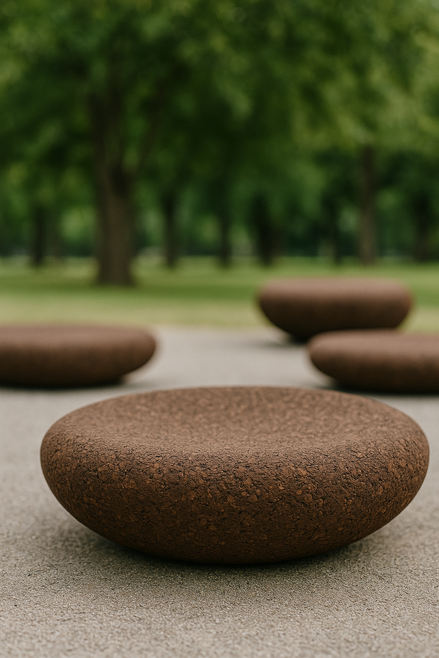
Designed to be walked on with bare feet, Lily Pad is made from expanded cork agglomerate, a method of processing cork at high temperature that gives it a darker colour and a stronger, more characteristic aroma. Dominic Leong explains that these properties of cork are perfectly suited to the goal of exploring the more playful side of cities. He added: ‘the fantastic thing about cork is its tactility and its thermal qualities, so in a setting like this, it’s not too hot to sit on (...) and offers a level of comfort that adds something to the public space. There are many possibilities for using cork to make urban spaces more comfortable, inclusively through street furniture and urban landscapes. Cork adds a bit of softness to hard spaces, which inspired us from the start: how can we soften these public spaces, and make them more comfortable?’
At the centre of the creative process was the material characteristics of cork and the way that it instantly connects to nature: ‘First, we looked at cork in its particle form and thought about how to increase the scale of this pattern to create a flexible and adaptable landscape, that can be moulded into what we call Lily Pads, a kind of playful interpretation, connected to nature. We also thought about how the Lily Pads are fluid and move. It’s an individual sculptural element to sit on and play with, but can also be transformed into a larger landscape, depending on the urban space, so the idea of working with different scales facilitates adaptability and flexibility.
Cork brings a little softness to hard spaces, which inspired us from the outset: how can we soften these public spaces, and make them more comfortable?”